The shortest-looking plan isn’t always the easiest climb. A Machame route 7 day trek gives you a full week on the mountain, but each day’s distance, altitude and recovery time matter as much as the number of days. If you’re wondering whether that pace leaves enough room to adjust to the elevation, it’s a fair question.
The seven-day itinerary progresses in stages, with changes in altitude that shape how your body responds. No schedule can guarantee how you’ll acclimatize or whether you’ll reach the summit. Reviewing the daily demands can help you judge the route beyond headline success claims.
This guide explains how the trek unfolds, what the seven-day pace means for acclimatization and what to consider when deciding whether it suits your fitness and comfort with altitude. It also covers preparation and the role of experienced guides and mountain support. African Hiking Tours And Safaris offers a guided Machame climb, informed by its founders’ experience as porters and guides.
Key Takeaways
- See how the seven-day Machame itinerary is structured and what to consider at each stage.
- Understand why the itinerary length alone can’t predict how your body will respond to altitude or whether you’ll reach the summit.
- Use this Machame route 7 day trek overview to weigh the itinerary’s pace against your experience, fitness and available time.
- Consider personal health factors and seek appropriate medical advice before planning a high-altitude trek.
- Explore a guided Machame climb with experienced guides and mountain support from African Hiking Tours And Safaris.
What the 7-Day Machame Route Trek Is Like on Kilimanjaro
It’s sensible to ask what “seven days” really promises. The Machame route 7 day trek is a defined mountain itinerary, not a promise that every climber will reach Uhuru Peak. It describes the time set aside for the climb. How each person responds to altitude, fatigue and the demands of each day can differ.
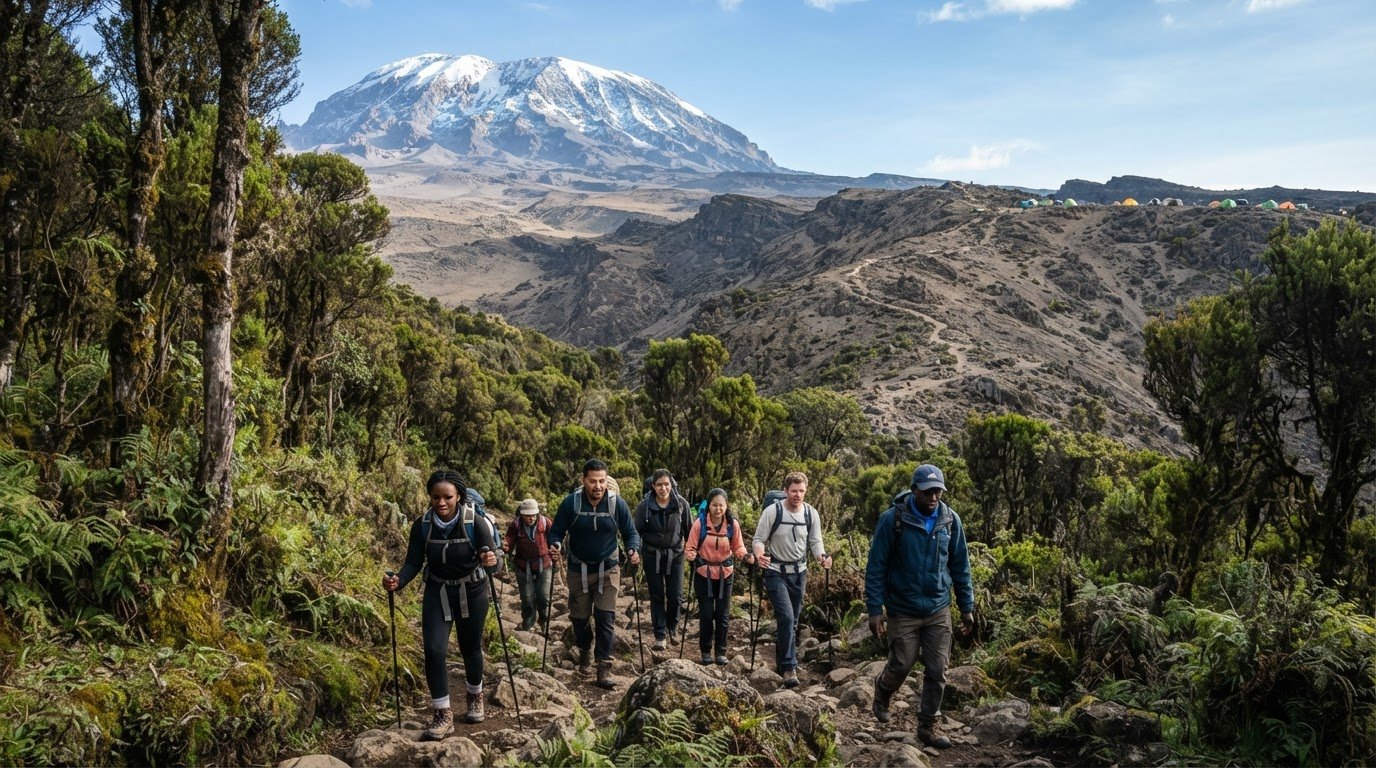
Machame is a guided trekking route on Mount Kilimanjaro. Over seven days, you move up the mountain in stages, sleep at planned camps and continue toward the summit before descending. The landscape changes from forest to open moorland and then to stark, higher alpine terrain. The mountain and the effort of the journey are central to the experience; the itinerary does not promise particular wildlife sightings.
“Seven days describes the itinerary, not an individual trekker’s summit outcome.” A schedule gives the climb structure, while personal readiness and response to altitude shape the experience on the mountain.
Where the Machame route travels on Kilimanjaro
The route begins at Machame Gate, within Kilimanjaro National Park, and approaches the mountain from its southern side. From the forested lower slopes, the trail climbs toward higher ground and continues through changing terrain toward the summit area. After the summit attempt, the usual route descends on the Mweka side. For background on the mountain’s geography and varied zones, see Mount Kilimanjaro.
This route direction helps you picture the journey: enter from the Machame side, gain height over successive stages, then descend by a different route. Camps and daily arrangements can vary by itinerary, so a route overview is not a substitute for the day-by-day schedule.
What seven days means for the trek schedule
Seven days refers to the mountain trekking itinerary, not necessarily the full time you’ll spend travelling. Getting to the climb and making arrangements after it are separate from those trekking days. Account for that distinction when planning time away, transfers and the rest of your trip.
Camp choices, walking times and trip arrangements can differ between itineraries. African Hiking Tours And Safaris offers a guided seven-day Machame climb with experienced guides and mountain support. Its founders’ experience as porters and guides informs their approach to leading on the mountain. Review the specific itinerary you’re considering, paying attention to each day’s demands and the overall pace rather than relying on the duration alone.
Machame Route 7-Day Itinerary: Follow the Camps to the Summit
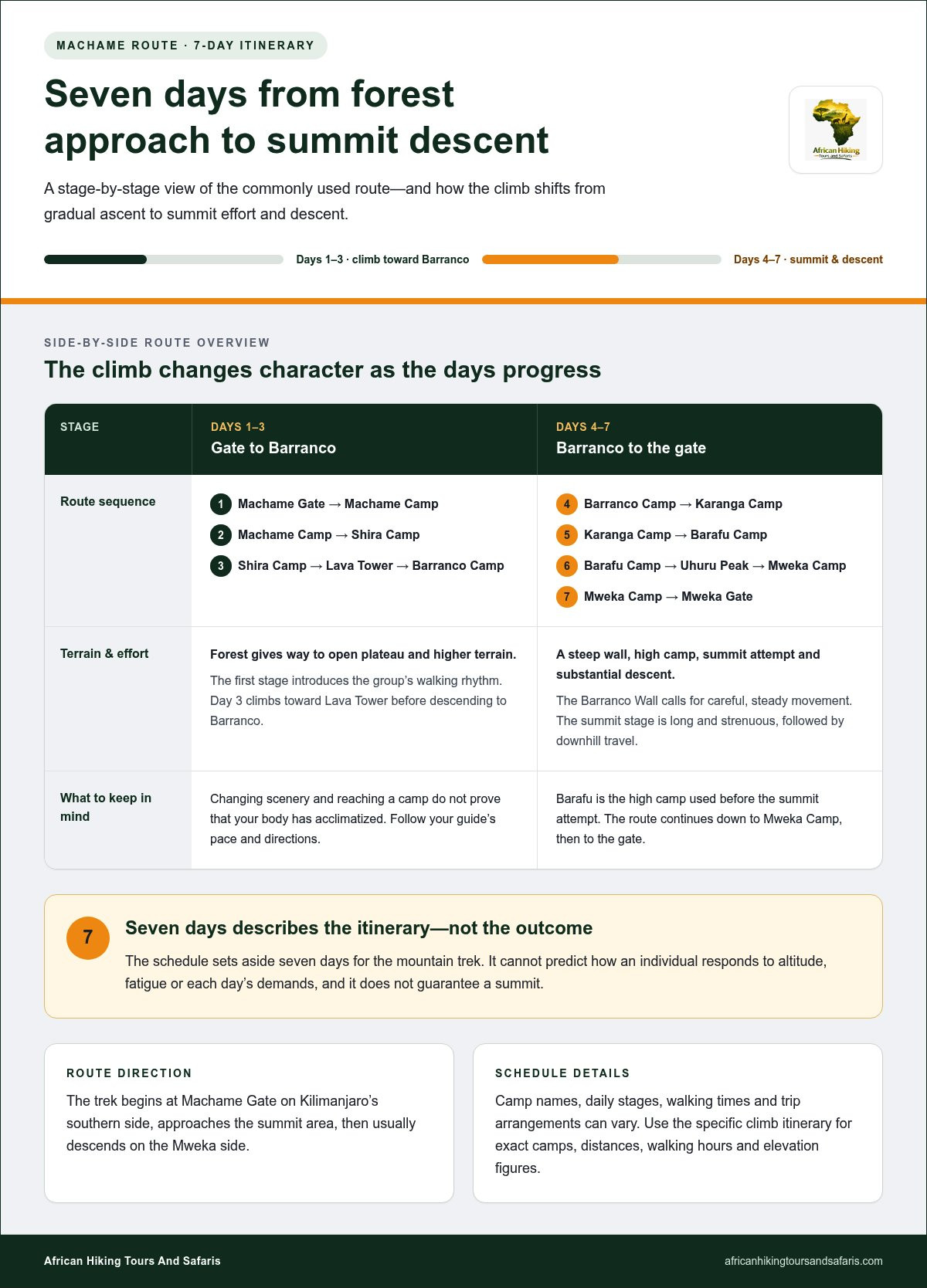
A seven-day plan is easiest to picture as a steady climb, a summit push and a descent. The sequence below reflects a commonly used Machame itinerary. Camp names and daily stages can differ, so use the itinerary for your climb as the reference for exact camps, distances, walking hours and elevation figures. Avoid combining figures from different schedules.
Days 1-3: From Machame Gate to the Barranco area
- Machame Gate to Machame Camp. The trek begins with an ascent through forest. This first stage introduces the rhythm of walking with a group while gaining height gradually.
- Machame Camp to Shira Camp. The trail climbs out of the forest toward more open ground on the Shira Plateau. The landscape changes, but scenery alone doesn’t show how your body is adapting to altitude.
- Shira Camp to Lava Tower, then Barranco Camp. On itineraries with this stage, the route climbs toward Lava Tower before descending to Barranco. This day includes movement across different elevations before the night at Barranco.
These stages involve more than walking through changing scenery. The forest, plateau and high, open terrain each bring a different feel underfoot and in the air. The planned daily movement also shapes the climb. Follow your guide’s pace and directions, and don’t treat reaching a particular landscape or camp as proof that you’ve acclimatized.
Days 4-7: Barranco, summit night and descent
- Barranco Camp to Karanga Camp. The day typically begins with the Barranco Wall, a steep section that calls for careful, steady movement. The trail continues toward Karanga.
- Karanga Camp to Barafu Camp. This stage advances to Barafu, the high camp used before the summit attempt. Conserve energy for the remaining effort and follow the schedule set by your guides.
- Barafu Camp to Uhuru Peak, then Mweka Camp. The summit attempt climbs toward Uhuru Peak before the route descends to Mweka Camp. It’s a long, strenuous stage that combines the climb’s highest objective with a substantial descent.
- Mweka Camp to the gate. The final day continues downhill to Mweka Gate. This descent completes the route after the summit stage.
Read the itinerary as one connected journey: the Barranco Wall comes before the move to Karanga and Barafu, while the summit day is followed by a descent to Mweka and then the gate. To see how these stages fit into African Hiking Tours And Safaris’ guided seven-day Machame climb, review the specific trip itinerary, including its camps and daily figures.
Is Seven Days Enough on Machame? Understand Pace and Acclimatization
Seven days is the length of an itinerary, not a universal measure of what your body can manage. Whether the Machame route 7 day trek is a suitable pace depends on your health, preparation, response to altitude and the specific schedule, including how the days are arranged. A longer climb can allow more time for gradual progression, but extra days don’t guarantee a summit either.
Acclimatization is the body’s adjustment to having less oxygen available at higher altitude. That adjustment varies from person to person. Being fit enough to walk for hours can help with the physical effort, but it doesn’t predict how you’ll respond to altitude. A route name or published success figure can’t make that prediction for you.
How the Machame itinerary handles changes in altitude
Look at the elevation pattern of the specific itinerary, not just its total number of days. On schedules that climb from the Shira area toward Lava Tower and then descend to Barranco for the night, the day includes an ascent followed by a lower sleeping elevation. This is often described as “climb high, sleep low.” It can be part of an acclimatization strategy, but it doesn’t remove altitude risk or ensure that someone will adapt well.
Check how the remaining stages build toward the summit and whether the schedule includes a separate movement day before the summit attempt. The seven-day Machame plan described here divides the approach from Barranco toward Barafu across two days, rather than compressing that stretch into one. That shapes the effort and the time spent on the mountain, but it still can’t guarantee an individual outcome. Follow the actual itinerary and your guides’ directions; not every Machame schedule uses identical camps or timing.
What summit-success statistics can and cannot tell you
Summit-success figures are meaningful only alongside the details behind them. An operator’s reported result may refer to its own climbers and a particular time period, itinerary or method of counting attempts. A mountain-wide estimate, where available, may draw on a broader mix of routes, durations and reporting practices. These figures aren’t automatically comparable, and a reported rate shouldn’t be treated as a prediction for every trekker.
“A summit-success rate is useful only when you know which route, duration and reporting method it describes.” Check what the figure counts, such as whether it includes all booked climbers or only those who begin the trek, and whether it refers specifically to the seven-day schedule. Without that context, a percentage can sound more certain than the underlying information allows.
Use statistics as background, not as a promise. A seven-day schedule may suit someone with limited time, while another climber may prefer a longer itinerary for a more gradual pace. Weigh the actual day-by-day progression, your circumstances and the guidance of qualified professionals before deciding which climb feels right.
How to Decide Whether the Seven-Day Machame Trek Fits You
Choose by comparing the itinerary with your real-life capacity, not an ideal version of your fitness or schedule. The Machame route 7 day trek involves consecutive days on foot, changing terrain and a demanding summit attempt. These questions can help you identify what you’re ready for and where you may need more preparation.
Questions to consider before choosing this itinerary
- Can you make room for the whole climb? Set aside the full trekking schedule, then plan separately for travel arrangements around it. Seven trekking days don’t necessarily represent the entire trip.
- Are you comfortable with sustained effort? Consider how you manage several walking days in a row, uneven or steep ground, and continuing when you’re tired. The summit attempt is a distinct challenge, not simply another routine hiking day.
- What does your trekking experience tell you? Previous hikes can help you understand how you manage long days, changing conditions and recovery. They can guide your preparation, but they can’t predict your response to altitude.
- Does the schedule leave you feeling prepared? Read the day-by-day itinerary and consider whether its progression and pace suit your circumstances. If the allotted time feels too tight, think carefully before committing to that schedule.
Fitness and health are related, but they aren’t interchangeable. If you have a health condition, take medication or have concerns about strenuous exercise at high altitude, discuss the climb with an appropriate medical professional before making plans. Share the itinerary so the conversation can account for its duration and physical demands.
Prepare for the mountain without overcomplicating the decision
Start with gradual conditioning that builds your comfort with sustained walking, rather than trying to cram preparation into the final days. Review the itinerary and note the longer or more challenging stages. This gives your training a practical focus without turning preparation into a test of summit readiness.
Keep planning manageable. The detailed How to Prepare for a Kilimanjaro Trek guide can support broader preparation, while Training for a Kilimanjaro Climb can help you think through conditioning. For equipment questions, use the Kilimanjaro Trek Packing List for a Guided Climb as a separate reference rather than trying to solve every detail at once.
Choose the seven-day option because its schedule fits your time and you’re willing to prepare for its sustained effort, not because a particular duration guarantees success. African Hiking Tours And Safaris offers a guided Machame climb with experienced guides and mountain support. Explore our guided Machame Route climb as you consider whether this itinerary is the right fit.
Planning a Kilimanjaro Summit on Christmas
Summiting Kilimanjaro on Christmas Day gives the climb a clear date and a memorable purpose. To reach Uhuru Peak on 25 December, plan the summit stage as part of the full itinerary rather than treating Christmas as a separate event.
Build the Christmas summit date into the itinerary
If you want to stand at Uhuru Peak on Christmas Day, the summit push will usually begin late on Christmas Eve from Barafu Camp. Count backward from 25 December when choosing your departure date, then check the exact camp sequence, trekking days and summit timing with your guides. The seven-day Machame itinerary described here includes the approach to Barafu, the summit attempt and the descent to Mweka.
Plan the rest of your Christmas trip
Allow time before the trek for arrival, transfers and preparations, and plan separately for the journey after the descent. Your Christmas celebration will take place within a demanding mountain schedule, so arrange accommodation, transport and any post-trek plans around the trekking dates rather than assuming the summit day is the only date that matters.
Confirm your Christmas climb early
Share your Christmas summit goal when discussing the climb with your operator. Confirm the departure date, itinerary, camps, summit timing and mountain support, then prepare your clothing and equipment for the complete route. African Hiking Tours And Safaris can help you plan its guided Machame climb around your chosen Christmas summit date.
Book a Guided 7-Day Machame Route Trek with African Hiking Tours And Safaris
If the route, pace and time commitment feel right for you, a guided climb can turn your planning into a clear next step. African Hiking Tours And Safaris offers a guided seven-day Machame Route climb on Mount Kilimanjaro, with experienced guides and mountain support. It’s a structured trekking experience, not a self-guided route.
What a guided Machame climb means
Experienced guidance and mountain support are important parts of a high-altitude trek. They provide a team structure as you move through the itinerary, while the mountain still asks you to take each day steadily and pay attention to how you feel. A guided climb doesn’t remove the physical demands or guarantee a particular summit outcome; it provides support as you follow the planned route.
The company’s founders have firsthand mountain backgrounds that include work as porters and guides. That experience informs a grounded perspective on what it takes to travel on the mountain and the importance of treating the climb, its people and its environment with respect. Know the itinerary, prepare for the effort and take the journey one stage at a time.
A guided package is distinct from arranging a route independently. This offering centers on the climb itself, with guides and mountain support. Review the actual day-by-day schedule: consider how its stages fit your available time, whether the pace feels appropriate and what preparation you can make before departure.
Turn your route decision into a clear next step
Your choice is strongest when three considerations work together: the itinerary’s pace, the time it allows for acclimatization and your readiness for sustained effort at altitude. No one factor settles the decision alone. A seven-day schedule may suit your plans, but weigh the physical demands carefully and discuss relevant health concerns with an appropriate medical professional.
Keep the planning grounded. Review the itinerary and make sure you understand the sequence of trekking days, then give yourself time to build general fitness gradually. You don’t need to answer every packing or training question before deciding whether the route interests you. Work through those details as part of preparation, leaving room for the fact that each trekker’s experience can differ.
African Hiking Tours And Safaris brings experienced guides and mountain support to its guided Machame climb. If the route aligns with your goals and you’re ready to explore the next step, Take the next step toward your Machame climb.
Take Your Next Step Toward Kilimanjaro
Make your decision with a clear understanding of the climb and an honest sense of what you’re ready to take on. The Machame route 7 day trek can be a meaningful goal to work toward, but a good plan leaves room for preparation and recognizes that each person experiences the mountain differently.
African Hiking Tours And Safaris offers a guided seven-day Machame Route climb with experienced guides and mountain support. The founders’ professional experience as mountain porters and guides brings firsthand understanding of mountain life to the journey. Review the route carefully and choose the climb that fits your goals.
Explore our guided 7-day Machame climb, and take the next step toward your Kilimanjaro adventure with confidence.
Frequently Asked Questions
Is the Machame route difficult to climb in seven days?
It can be demanding, especially if you’re unused to consecutive days of walking or steep, uneven trails. The seven-day schedule includes a strenuous summit attempt, so consider more than general fitness: think about how you manage sustained effort and recover between active days. A strong hiking background can help you prepare, but it can’t predict how you’ll respond to altitude. Review the daily itinerary to understand the pace before deciding.
How long does the 7-day Machame trek take from start to finish?
The mountain itinerary takes seven trekking days, from the start at Machame Gate through the descent to the exit gate. That count describes the climb itself, not necessarily the full time you’ll need for travel arrangements before or after the trek. For planning, separate the seven-day schedule from the rest of your trip and use your itinerary to see which day includes each camp transition and the final descent.
What happens on summit night on the Machame route?
The summit attempt usually begins late at night from Barafu Camp, with climbers moving slowly toward Uhuru Peak in darkness and cold conditions. Reaching the summit is followed by a descent, commonly to Mweka Camp, making this a long and physically demanding stage. The exact timing and experience depend on the itinerary and conditions. Follow your guide’s direction, and remember that continuing or turning back depends on how the climb is unfolding.
Can beginners climb Kilimanjaro via the Machame route?
Beginners may consider Machame, but should be realistic about the sustained effort and altitude involved. Previous high-altitude experience doesn’t guarantee readiness, and its absence isn’t automatically a reason to rule out the climb. Build up your hiking comfort before departure and study the day-by-day demands. If you have health concerns or questions about strenuous activity at altitude, discuss them with an appropriate medical professional.
Does the Machame route have a better summit success rate than other routes?
There isn’t one dependable comparison that predicts your personal outcome. Published rates can reflect different trek durations, operator groups, time periods and counting methods, so figures may not be directly comparable. A longer itinerary can provide more time on the mountain, but no route length guarantees a summit. Treat any reported statistic as context only, and focus your decision on the actual schedule, your circumstances and the guidance provided during the climb.
What is the best way to prepare for a 7-day Machame trek?
Prepare gradually by building your ability to walk for sustained periods and recover between active days. For example, increase the duration of regular hikes over time rather than relying on a few intense sessions just before departure. Read the itinerary closely to see where the longer or more demanding stages fall. If a health issue could affect strenuous exercise or altitude exposure, seek advice from an appropriate medical professional before travelling.